
In a recent Deseret News article, Stephen Cranney discusses survey data suggesting that Latter-day Saints and Evangelicals experience religious discrimination within academia. While religious discrimination is a legitimate concern, I believe there is another dimension to this conversation that warrants serious consideration: the relationship between fidelity to particular religious and ideological commitments and academic credibility.
Over the past several years, I have become increasingly concerned about the Deseret News’ role in cultivating and amplifying a network of scholars and institutions that privileges ideological conformity over critical inquiry. In examining the work of particular recurring contributors, I consistently encounter instances of selective engagement with evidence, questionable interpretations of data, and insufficient consideration of competing scholarship. Taken together, these raise concerns about a movement away from rigorous scholarly inquiry toward the instrumentalization of scholarship in the service of ideological advocacy.
In this context, we ought to consider whether some unfavorable assessments of religiously affiliated scholars within the wider academic community reflect religious discrimination or legitimate concerns about scholarly rigor. A scholar’s religious beliefs need not compromise the integrity of their scholarship. However, an inability or unwillingness to critically examine the assumptions arising from those beliefs can.
From data-driven apologetics to epistemic closure
The very interpretive practices that confer credibility within an ideologically affirming community may undermine a scholar’s credibility within the wider academic community. However, when unfavorable assessments of religiously affiliated scholars are interpreted primarily through the lens of religious discrimination, the potential for meaningful scholarly and institutional self-examination is diminished. This is particularly concerning when we consider the potential for epistemic closure: a condition in which a community’s framework for interpreting knowledge becomes increasingly resistant to contradictory evidence.
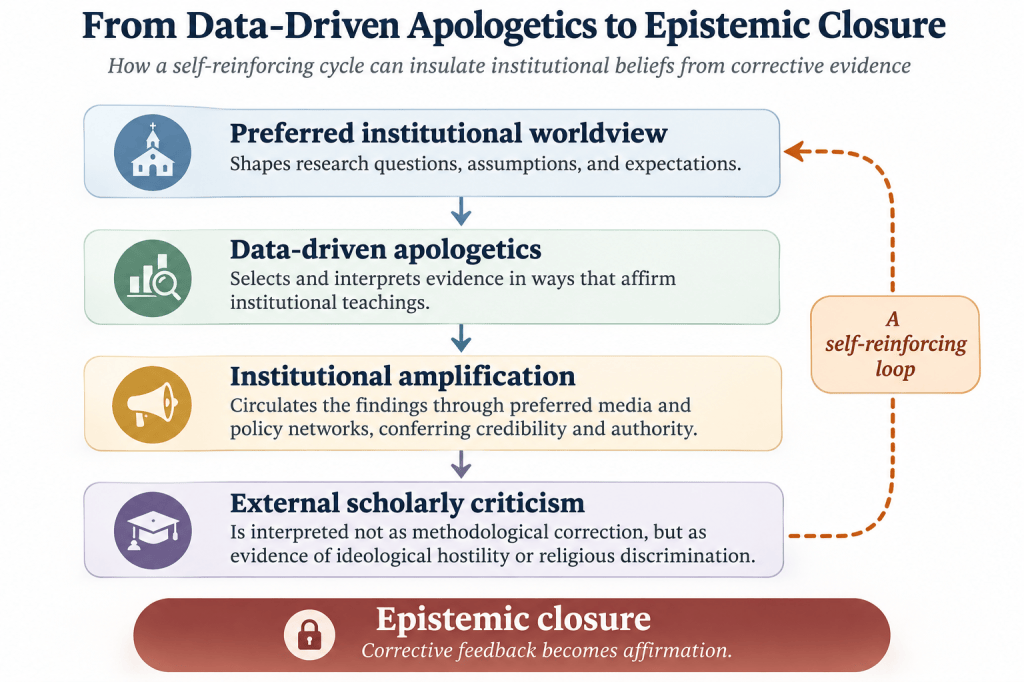
Consider how a self-reinforcing epistemic loop might develop:
- If scholarship affirms institutional teachings, it is received as evidence of their truth.
- If scholarship challenges institutional teachings, its assumptions or methodologies are regarded with suspicion.
- If the wider academic community criticizes the institution or its scholars, that criticism is interpreted as evidence of secular hostility or religious discrimination.
- If the institution’s academic standing declines, that decline is understood as the price of religious fidelity.
Under these conditions, what mechanism remains for recognizing when our institutions, scholars, or inherited assumptions might be mistaken? Even adverse outcomes can be interpreted as affirmations of institutional righteousness rather than invitations to self-examination.
Scholarly inquiry or data-driven apologetics?
Ironically, Cranney’s article on religious discrimination itself illustrates some of my concerns. Although he describes several distinct measures of religious bias, his broader conclusions do not consistently preserve the distinctions between perceived departmental receptivity, unfavorable attitudes toward religious groups, hypothetical hiring preferences, and experiences of discrimination. For example, he characterizes Yancey’s findings on hypothetical hiring preferences as levels of hiring discrimination. While these findings provide meaningful evidence of discriminatory attitudes, they do not establish the prevalence of discrimination in actual hiring decisions.
Cranney also presents survey findings without discussing important limitations related to response rates and generalizability. For example, the methodological documentation for the 2025 Ohio State University survey, which Cranney describes as nationally representative, reports a response rate of 8.4%. Although the researchers employed stratified random sampling and demographic weighting, the low response rate raises questions about potential nonresponse bias that warrant consideration when generalizing the findings to the wider academic community.
Furthermore, in an otherwise favorable 2012 review of George Yancey’s research, on which Cranney substantially relies to support his claims about hiring discrimination, BYU sociology professor Bruce A. Chadwick identifies potential sampling bias, low response rates, modest differences in mean bias scores, and concerns regarding the research design. He expresses particular concern about the generalizability of the survey findings to the wider academic community. Given Cranney’s previous public emphasis on the importance of representative data, his omission of these methodological limitations is particularly noteworthy.
Cranney also inaccurately presents the chronology of the research, stating that George Yancey surveyed academics a decade after Tobin and Weinberg’s 2007 study. Yancey’s research was conducted in 2008, and his book was originally published in 2011. The 2017 date refers to the paperback edition. This error gives readers the mistaken impression that the two studies provide evidence of academic bias at substantially different points in time. We are all susceptible to motivated reasoning to varying degrees, and even conscientious scholars make methodological and interpretive errors. However, a cursory examination of Cranney’s broader public scholarship raises concerns about recurring interpretive practices and evidentiary standards.
A review of the headlines of the 41 articles currently listed in Cranney’s Deseret News author archive, together with a closer examination of several of these articles, suggests a recurring pattern of what might be characterized as data-driven apologetics rather than rigorous scholarly inquiry. Consider such headlines as:
- Religion isn’t sexually repressive.
- Are religious people happier? The science is pretty clear.
- The religious are happier. The question is why
- Latter-day Saints, Evangelicals among most discriminated-against groups in academia
Beyond the ideological orientation of these pieces, I am struck by the degree of certainty with which complex social science findings are communicated. For example, in his 2023 article on religion and sexual repression, Cranney draws on research concerning sexual frequency and satisfaction to challenge the characterization of religion as sexually repressive. Yet sexual frequency, sexual satisfaction, and sexual repression are distinct constructs. Evidence of greater reported sexual satisfaction among religious married couples does not establish the absence of sexually repressive beliefs, practices, or socialization. In his 2024 article on religion and happiness, Cranney goes beyond the certainty conveyed in the headline, stating, “Sometimes researchers will say ‘it’s complicated,’ but it’s really not.” Although he acknowledges some qualifications elsewhere in the article, this characterization minimizes the complexity of a relationship that warrants consideration of variation across populations, religious environments, social contexts, and individual experiences.
This raises questions about the distinction between scholarly inquiry and what might be characterized as data-driven apologetics. The problem is not necessarily the accuracy of the data themselves, but the selection of research questions, the consistency with which methodological limitations are interrogated, the interpretation of findings, and the conclusions readers are encouraged to draw. I can imagine that when evaluating a candidate for a research or teaching position, these recurring practices in the candidate’s public communication of research would raise substantive concerns about evidentiary fidelity and intellectual judgment, irrespective of the candidate’s religious affiliation.
Academics have an ethical responsibility to represent research as accurately as possible rather than instrumentalizing it in the service of a preferred worldview. Communicating with a general audience may require simplifying complex research, but simplification should not come at the expense of evidentiary fidelity. Indeed, the responsibility is arguably greater when addressing audiences who may lack the methodological expertise to independently evaluate the claims being made. The media institutions that frame and disseminate this scholarship share that responsibility.
Religious discrimination and institutional epistemic closure are not mutually exclusive possibilities. A religious community can experience genuine prejudice while simultaneously engaging in intellectual practices that undermine its own academic credibility. A commitment to truth requires that we be willing to examine both.
Notes
1. Sampling and representativeness. According to the methodological documentation for the 2025 Ohio State University survey, 16,218 faculty and instructional staff were invited to participate, with 1,360 responding (an 8.4% response rate). The final sample consisted of 1,048 respondents following data cleaning. The researchers employed stratified random sampling and demographic weighting for the full-time faculty subsample. Although a low response rate does not necessarily establish nonresponse bias, it warrants consideration when assessing the generalizability of the findings.
The sampling methodology employed in this study differs from the convenience sampling methodology Cranney and Coates critique in their May 2026 article. I am not suggesting that these methodological limitations are equivalent. Rather, my concern is with the consistency with which limitations affecting representativeness are communicated to readers.
2. Distinguishing empirical constructs. Perceived departmental receptivity, unfavorable attitudes toward religious groups, hypothetical hiring preferences, and actual discriminatory behavior are related but distinct phenomena. Evidence of a stated reluctance to hire individuals based on religious affiliation provides meaningful evidence of discriminatory attitudes but does not directly establish the prevalence of discrimination in actual hiring decisions.
3. Scope of assessment. My observations concern Cranney’s public-facing communication and interpretation of empirical research rather than a comprehensive assessment of his academic publication record. I also recognize that headlines may reflect editorial decisions rather than those of the author alone. This consideration reinforces the importance of examining the ethical responsibilities of both scholars and the media institutions that disseminate their work.
4. Sampling Methodology and Representativeness. Low response rate does not in itself establish nonresponse bias. Additionally, the sampling methodology employed in the Ohio State study differs from the convenience sampling methodology Cranney and Coates critique in their May 2026 article. I am not suggesting that these methodological limitations are equivalent. Rather, my concern is with the consistency with which limitations affecting representativeness are communicated to readers.




Leave a Reply