A recent Deseret News article on faith deconstruction, opens with the following statement: “If I could convince those wanting to think critically about their faith of anything, it would be not to place too much faith in critical thinking.” Meagan Kohler, a frequent Deseret News contributor, makes a valid observation: our reasoning is influenced by our emotional experiences, social environments and existing commitments. But this is equally true of those who defend religious institutions. More fundamentally, her argument overlooks important dimensions of religious disaffection.
In my study of religion and society, and in my conversations with people who have distanced themselves from institutional religion, I have encountered something that is frequently overlooked in discussions about declining religious participation. Many are not struggling with a loss of faith in God. They are struggling with a loss of faith in institutions that claim to represent God. Some have experienced profound personal harm, including sexual abuse or marital betrayal, compounded by the responses of religious leaders. Others have waited decades for meaningful institutional acknowledgment of historical injustices. Still others are deeply troubled by what they perceive as a failure of religious leadership to confront contemporary abuses of power.
Many of these individuals are evaluating their religious institutions according to the very moral principles those institutions taught them. They expected the courage of the prophetic tradition in confronting injustice. They expected honesty about the past and a willingness to repent when harm had been done. Perhaps, before questioning the intellectual processes of those who are becoming disillusioned with institutional religion, we should more seriously examine the institutional conditions contributing to that disillusionment. In other words, we get further by listening than lecturing.
Different kinds of religious disaffection
Several experiences are often collapsed into the category of faith deconstruction.
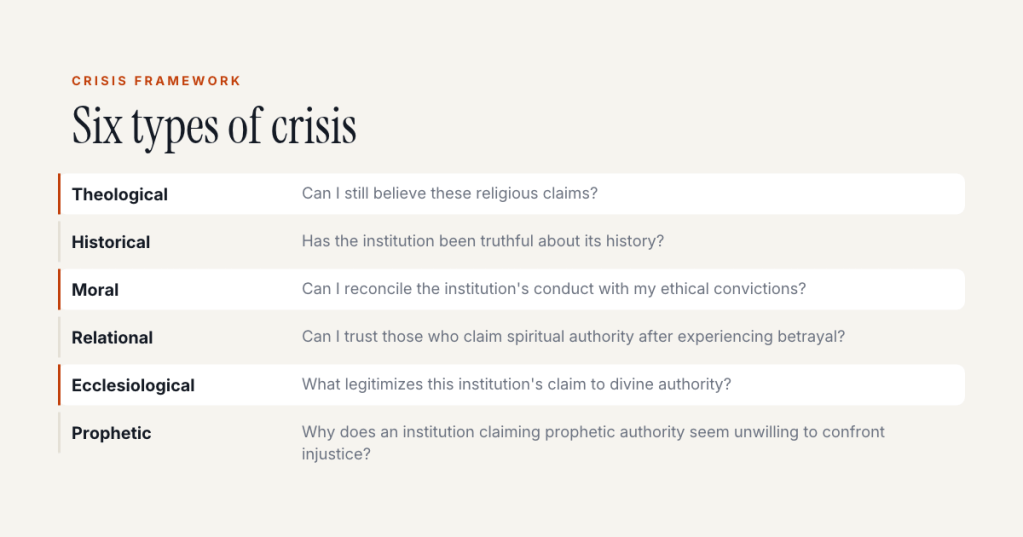
These experiences frequently overlap.
Kohler suggests that perhaps even a majority of people who deconstruct their faith ultimately abandon religion and belief in God. Yet she offers no empirical evidence to support this claim. Nor does she adequately distinguish between disengagement from a particular religious institution, the reconstruction of one’s religious beliefs and the abandonment of belief in God. Collapsing these experiences into a single narrative of faith loss obscures much of what we need to understand about religious disaffection.
Her distinction between a machine and a living organism is rhetorically effective, but it is not a particularly rigorous philosophical argument. Living organisms can be studied, examined, diagnosed and treated. We can distinguish healthy growth from pathological growth. A gardener can recognize disease, remove damaged branches and examine the conditions that are preventing a plant from flourishing. The metaphor could just as easily support religious reform and critical examination. Moreover, the survival of a belief is not necessarily evidence of its truthfulness. Nor should we presume to know the condition of another person’s heart based on whether they share our religious convictions.
Critical thinking and the prophetic tradition
Consider the biblical prophets. Much of what they did was critically examine the religious assumptions, practices and power structures of their own communities. Their faithfulness to God frequently required challenging established religious authority. The biblical prophetic tradition is deeply concerned with the moral accountability of communities and their leaders. The prophets repeatedly challenge religious observance that coexists with injustice.
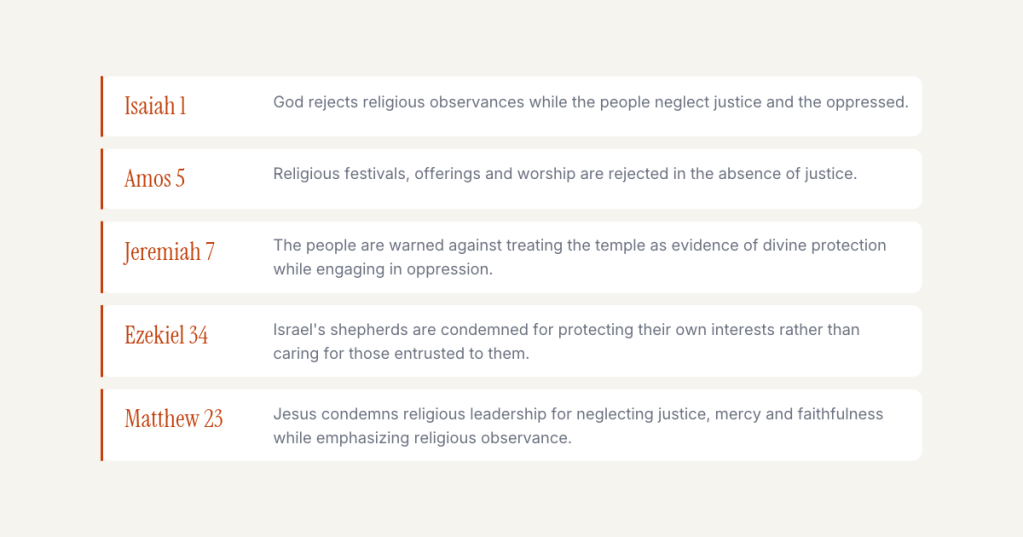
In these texts, the problem is not that people are insufficiently committed to religious belief. It is that religious communities and their leaders have become insufficiently committed to the moral demands of their religion. Some people leaving institutional religion may, in fact, be responding to the very moral imperatives of the prophetic tradition. They expected prophetic courage. They expected moral clarity in the face of abuses of power. They expected an institution that would model repentance rather than merely preach it. They expected the protection of vulnerable human beings to take precedence over institutional reputation. Those expectations did not originate in secularism. They originated, at least in part, in their religious formation.
This certainly is not to suggest that those who remain committed to religious institutions are indifferent to injustice. Religious institutions and communities can be profound sources of healing, belonging, meaning and moral formation. These realities can coexist within the same institution. One person’s experience of healing within a religious institution does not invalidate another person’s experience of harm. Our own positive or negative experiences should not become the lens through which we judge the legitimacy of someone else’s experiences.
Whose knowledge and experiences are granted authority?
It is worth considering how interpretive authority is distributed: whose interpretations of religious experience are privileged, whose are marginalized, and who gets to determine the legitimacy of those interpretations?
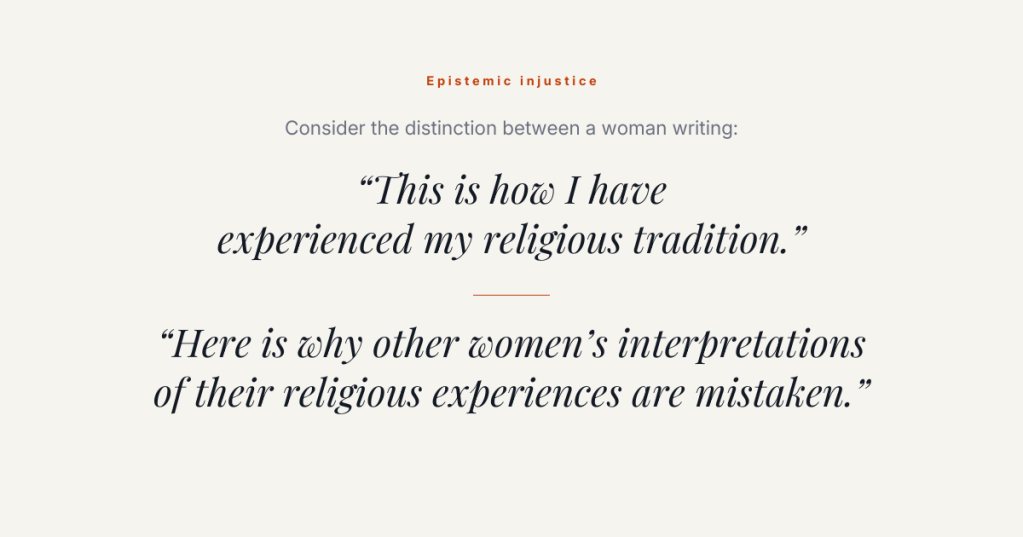
The second requires considerably more intellectual and ethical responsibility, particularly when supported and distributed by the institution whose practices are being questioned.
The Deseret News appears to repeatedly turn to Kohler for interpretations that affirm the institution’s position in response to emerging social issues, institutional challenges and concerns expressed by members. Her subject matter encompasses sociology, psychology, epistemology, gender studies, religious disaffiliation, reproductive ethics and institutional inequality. It is curious to me why the Deseret News repeatedly confers epistemic authority on this particular opinion writer across such a broad range of disciplines. The concern is not that Kohler has a particular perspective or that she is given a platform to express it. Her perspective is a legitimate part of the conversation. The problem is the recurring editorial choice to amplify voices whose perspectives consistently affirm existing arrangements rather than engage with perspectives that might help the institution better understand and address the concerns being raised.
The Paradox of Faith-Promoting Commentary
There is a difference between publishing faith-promoting material that encourages deeper reflection and publishing commentary that reinforces an “us versus them” mentality. Given the Deseret News’s historical ambition to become an influential national voice for faith and family, the latter seems particularly counterproductive. It potentially alienates precisely the people with whom meaningful dialogue about religion would be most valuable.
An article may reassure one segment of the readership while simultaneously reinforcing another segment’s perception that the institution discourages independent thought. For someone who has experienced religious coercion, institutional betrayal, ecclesiastical mistreatment or the suppression of legitimate questions, the suggestion that their ability to discern truth depends upon conforming to a particular model of religious faithfulness may be profoundly alienating. And for an outside observer, it may reinforce perceptions of the Church as an authoritarian religious system intolerant of independent inquiry.
Imagine someone who has spent decades believing that prophets have a particular responsibility to confront injustice. They are watching cruelty, corruption, racism, misogyny or the abuse of political power. They turn toward their religious community expecting a morally serious response. Instead, in a newspaper owned by their religious institution, they encounter political commentary that appears to downplay or even justify the injustices they had hoped their religious community would confront. Then, when they begin questioning, the same religiously owned newspaper publishes an article cautioning them about the reliability of their critical thinking. There is something disturbingly circular about that. Commentary ostensibly intended to address religious alienation may reproduce the very conditions contributing to that alienation. The irony is that the Deseret News may be providing ideological reassurance to some readers while eroding the trust of others.
Other Sources to Explore
Institutional betrayal
- Smith, C. P., & Freyd, J. J. (2014). Institutional betrayal. American psychologist, 69(6), 575.
- Smith, C. P., & Freyd, J. J. (2011). Institutional betrayal: Violations of members’ trust surrounding incidents of sexual assault. Anxiety, 2(10).
Institutional betrayal occurs when trusted institutions harm those dependent upon them, including through failures to prevent harm or respond appropriately when harm occurs. The original injury can be compounded by the institution’s response. This is especially relevant to survivors of sexual abuse whose disclosures are minimized or mishandled by religious authorities.
Moral injury
- Shay, J. (2014). Moral injury. Psychoanalytic Psychology, 31(2), 182–191.
- Litz, B. T., et al. (2009). Moral injury and moral repair in war veterans: A preliminary model and intervention strategy. Clinical Psychology Review, 29(8), 695–706
- Harris, J. I., et al. (2015). Moral injury and psycho-spiritual development: Considering the developmental context. Spirituality in Clinical Practice, 2(4), 256–266.
Although initially developed in military contexts, this framework has considerable relevance to religious disillusionment, as moral transgressions by spiritual leaders or institutions frequently trigger profound religious and spiritual struggles.
Religious and spiritual struggles
- Exline et al. (2014): Exline, J. J., et al. (2014). The Religious and Spiritual Struggles Scale: Development and initial validation. Psychology of Religion and Spirituality, 6(3), 208–222.
- Pargament, K. I., & Exline, J. J. (2021). Religious and spiritual struggles and mental health: Implications for clinical practice. Spirituality and mental health across cultures, 395-412.
Their research distinguishes struggles involving God, interpersonal religious conflict, morality, doubt and ultimate meaning. Religious struggle is not a single phenomenon, nor does it necessarily indicate deteriorating spirituality.
The Sociology of Religion
- Berger, P. L. (2015). The sacred canopy. Sociology of religion, 21-26.
Religious institutions provide frameworks of meaning and legitimacy. When the institution’s conduct contradicts the moral universe it has helped construct, its capacity to sustain that universe can become compromised.
The Prophetic Tradition & Imagination
- Heschel, A. J. (1962). The prophets (Vol. 2, p. xvii). New York: Harper & Row.
- Rahko, S. E., & Craig, B. B. (2024). Prophetic dissent in dark times: the new Poor People’s Campaign and the rhetoric of national redemption. Review of Communication, 24(1), 4-16.
- Kaveny, C. (2016). Prophecy without contempt: religious discourse in the public square. Harvard University Press.
- De Gruchy, J. (2016). Kairos moments and prophetic witness: Towards a prophetic ecclesiology. HTS: Theological Studies, 72(4), 1-7.
- Brown, N. O. (1982). The prophetic tradition. Studies in Romanticism, 21(3), 367-386.
- Brueggemann, W. (2001). The prophetic imagination: Revised edition. Fortress Press.
A tradition that critically challenges existing social orders and seeks to transform them in accordance with divine justice. Its purpose is to confront injustice, inequality, and violence rather than legitimize established structures of power. Prophecy, in this understanding, is not primarily about predicting the future but about repeatedly recovering and renewing divine truth in response to human and institutional failures
Brueggemann makes a distinction between prophetic consciousness and dominant institutional consciousness. Prophetic ministry challenges established arrangements of power and legitimating narratives rather than merely sustaining them.
Exit, Voice, and Loyalty
- Hirschman, A. O. (1972). Exit, voice, and loyalty: Responses to decline in firms, organizations, and states. Harvard university press.
How the framework could map onto religious institutions
- Loyalty as a Buffer (and Barrier): In religious settings, loyalty is rarely just brand preference; it is tied to theology, family networks, community belonging, and salvation or ultimate meaning. High loyalty delays exit, giving institutions a long runway before leaders realize a problem exists.
- The High Cost of Voice: Many religious traditions have hierarchical governance, sacred authority claims, or strong norms around harmony and obedience. In these spaces, using “voice” (critiquing leadership, challenging doctrine, or advocating for structural change) often carries high social or spiritual penalties, such as marginalization or discipline.
- The “Exit” Paradox (Silent Attrition): In pluralistic religious landscapes where switching or disaffiliating (becoming a religious “none”) is socially acceptable, dissatisfied members often choose silent exit over costly voice. Because the most vocal reformers leave first, the remaining congregation becomes more homogenous, insulating leaders from internal feedback and accelerating institutional stagnation.
Useful for Analysis
- Explaining Congregational Decline vs. Reform: It helps diagnose why some denominations experience sudden membership drops after years of apparent stability- loyalty suppressed voice until a tipping point triggered mass exit.
- Examining Authority & Dissent: It clarifies how institutional structures either channel dissent into constructive renewal (institutionalized voice, like synods or lay committees) or force dissenters out.
- Studying Religious Disaffiliation: Researchers use it to distinguish between people who leave over specific institutional grievances (failed voice) versus those who drift away due to weakening community ties (eroding loyalty).




Leave a Reply