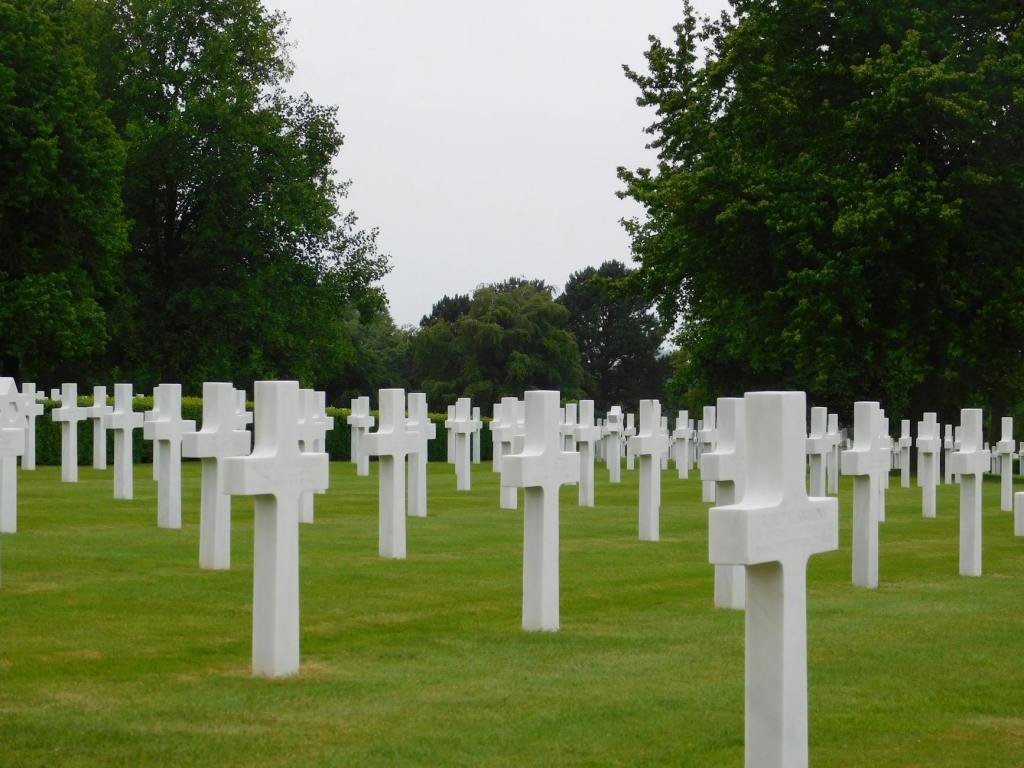
I recently visited the Netherlands American Cemetery in Margraten, where nearly 8,300 American soldiers from World War II are buried. It’s a beautiful, solemn place.
It’s also now the site of a disturbing controversy.
In spring 2025, two panels were removed from the cemetery’s visitor center after the Trump administration issued executive orders targeting diversity, equity, and inclusion programs. The panels had honored Black American soldiers who helped liberate Europe from Nazi rule. One told the story of George H. Pruitt, a 23-year-old Black soldier buried at Margraten who died in 1945 while trying to rescue a fellow serviceman from drowning. The other explained the racial segregation Black soldiers faced in the U.S. military during World War II. This is the more controversial one:
African American Servicemembers in WWII: Fighting on Two Fronts
During World War II, the U.S. military followed a strict policy of segregation. Despite the ongoing fight for civil rights at home during an era of racist policies, more than a million African Americans answered their nation’s call enlisting in every branch of the military.
Although limited to serving primarily in labor and support positions, Black service members regularly faced the horrors of war. In the fall of 1944, the 960th Quartermaster Service Company (QMSC), composed primarily of African Americans, arrived in Margraten to dig graves at the newly created cemetery. First Lieutenant Jefferson Wiggins of the 960th QMSC recounted the suffering of service members under his command who “cried when they were digging the graves… they were just completely traumatized.”
President Harry S. Truman finally ordered the US military to desegregate in 1948. However, African Americans’ fight for civil rights was far from over. Many Black soldiers, including Wiggins, returned home to become leaders in the Civil Rights movement. The achievements of African American service members in WWII served as a powerful claim for equality then and now.
That’s it. Historically factual and free of emotionally charged rhetoric. It was not an ideological attack on America. It simply stated that the U.S. military was segregated, that Black soldiers served despite racist policies at home, and that Black soldiers at Margraten dug graves under traumatic conditions.
After criticism over the removals, a replacement panel was installed. The replacement panel does reference African American units involved in digging graves, but it omits context about military segregation. That omission matters. Without it, visitors cannot fully understand why these soldiers’ experiences were historically distinct, or why their labor at Margraten carried such painful contradiction.
More than one million Black Americans served in World War II, risking their lives for a country that denied them equal opportunities. At the Netherlands American Cemetery, that unequal reality is quite literally buried in the ground itself.
During the brutal Winter of 1944 to 1945, this unit helped dig thousands of graves in frozen, miserable conditions. These men worked in the cold and mud, in a starving country under German occupation, preparing the ground where American dead would be buried. They handled the bodies. They marked the graves. They helped create the sacred landscape that visitors now experience as peaceful, and dignified. That deserves recognition. Black soldiers helped build the place of remembrance, but their own remembrance has been treated as controversial and inappropriate.
The response in the Netherlands has been anger and grief, including my own. Dutch officials, descendants of Black soldiers, historians, and local residents have objected.
More than eighty years later, the memory of the fallen is still actively carried by the people of the Netherlands. Local residents “adopt” graves and names on the Wall of the Missing. They tend the gravesites, place flowers on holidays, and learn about the soldiers’ lives to honor their sacrifice and ensure they are not forgotten.
The Dutch remember the Black American soldiers who helped liberate Europe, bury its dead, and build the cemetery itself, even when the United States still treated many of those same men as second-class citizens.
I asked the person in charge about the removal of the panels. Her answer was essentially that it was not their purpose to highlight one group at the exclusion of another.
That answer sounds neutral and fair. But when the historical narrative has already centered white soldiers, white leadership, white sacrifice, and white memory, adding the experiences of Black soldiers is not excluding everyone else. It’s correcting an exclusion that already existed.
Neutrality is not neutral when the record is already imbalanced.
For generations, Black Americans served a country that denied them full citizenship, segregated them in uniform, limited their roles, minimized their heroism, and then folded their sacrifice into a generic story of “American” bravery that too often meant white American bravery by default. To finally name their experience is not special treatment. It is historical honesty.
This is the problem with the anti-DEI logic in American institutions and culture. It treats the recognition of marginalized people and their struggles as divisive, while treating their absence from public memory, and opportunity as normal.
A cemetery is not just a place where bodies are buried. It’s a place where the living are told what’s worth remembering.
The men buried at Margraten deserve to be remembered. All of them. But remembering all of them requires telling the truth about all of them and the different burdens they faced.
The Dutch seem to understand this.
It’s shameful that some in the United States are choosing not to.




Leave a Reply