
Most of us genuinely want to do good. We see ourselves as caring, kind, informed, thoughtful and reasonable people. But good intentions alone do not prevent harm. In fact, without realizing it, we can unitentionally cause harm.
Most people today hear the word violence and think of a physical attack, war, and physical abuse. Yet many thinkers use the term in more broadly to describe a wide range of ways people are injured, limited, excluded, or made vulnerable by actions, systems, and stories [1]. In this way, violence includes anything that prevents people from meeting their basic needs or reaching their full potential, whether through direct action, social structures, or cultural beliefs.
Peace scholar Johan Galtung gave us a framework to understand this. He showed that violence and peace exist on three connected levels that shape our lives.
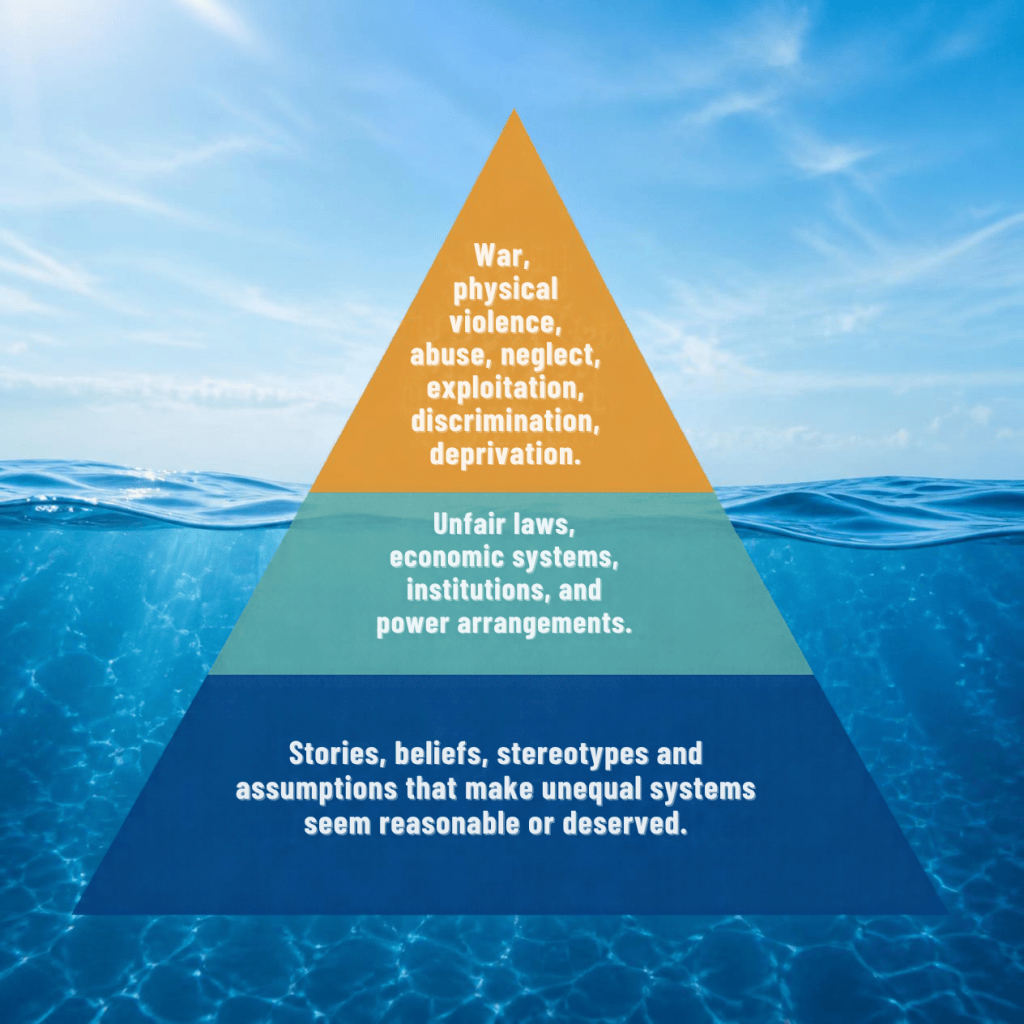
Direct Violence: What we can see
This is the harm that is more obvious: War, physical violence, abuse, neglect, exploitation, discrimination, deprivation.
It is what people experience in their bodies and lives. Direct violence is real and urgent, and it is the result of something deeper and less visible.
Structural Violence: What makes it happen
This is violence built into how society is organized. Unfair laws, economic systems, institutions, and power arrangements:
- limit people’s opportunities
- concentrate wealth and safety
- push risk and hardship onto others
No one person has to be cruel for structural violence to exist. The system does the work.
Cultural Violence: What makes it feel justified
This is the layer of stories, beliefs, stereotypes and assumptions that make unequal systems seem reasonable or deserved.
Cultural violence doesn’t usually sound violent. But it is what protects harmful systems from being questioned.
How the three levels connect
Culture shapes what we believe is normal or fair.
Structure turns those beliefs into policies, structures and systems.
Direct Violence is what people experience as a result.
When people suffer, it is often the predictable outcome of stories and systems working together.
Three Levels of Peace
Peace can be understood in a similar way—what we experience, how systems support it, and how culture sustains it. The same framework also shows us something hopeful. If harm is produced through actions, systems, and stories, then peace can be built the same way.
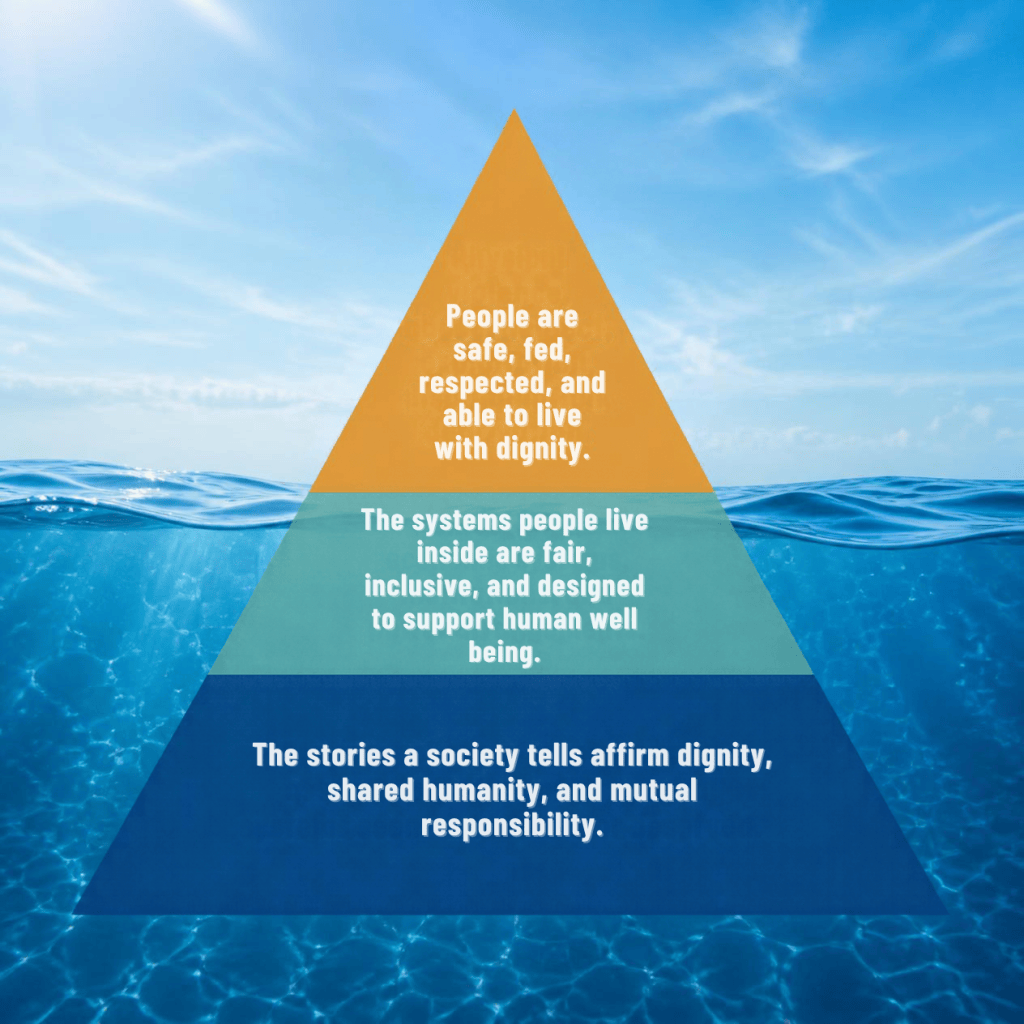
Direct Peace
People are safe, fed, respected, and able to live with dignity. The stories a society tells affirm dignity, shared humanity, and mutual responsibility.
Structural Peace
The systems people live inside are fair, inclusive, and designed to support human flourishing.
Cultural Peace
The stories a society tells affirm dignity, shared humanity, and mutual responsibility.
Why this framework matters
This way of thinking changes our approach. We can ask ourselves:
“What kind of world are we participating in and helping to create?”
It reminds us that real peace is not built only by kindness between individuals, but by shaping the systems and stories that surround us. This framework can help us to see violence and peace as patterns we can understand, question, and change.
Note
[1] Two influential scholars in peace building are Johan Galtung who is mentioned above, and Marshall Rosenberg. In “Nonviolent Communication” Rosenberg uses the term violence to include not only physical injury but also systemic, emotional, and institutional harm that diminishes human life. The book’s thesis is centered around communication skills that are essential for peace building.
Sources
Galtung, J. (1964). A structural theory of aggression. Journal of peace research, 1(2), 95-119.
Galtung, J. (1990). Cultural violence. Journal of peace research, 27(3), 291-305.
Galtung, J. (1964). Foreign policy opinion as a function of social position. Journal of peace research, 1(3-4), 206-230.
Galtung, J. (1969). Violence, peace, and peace research. Journal of peace research, 6(3), 167-191.
Leshem, O. A., & Halperin, E. (2020). Lay theories of peace and their influence on policy preference during violent conflict. Proceedings of the National Academy of Sciences, 117(31), 18378-18384.
Moore, D. (2021). Methodological Assumptions and Analytical Framworks Regarding Religion. Harvard Divinity School/Religion Matters
Moore, D. (2015). “Two: Diminishing religious literacy: methodological assumptions and analytical frameworks for promoting the public understanding of religion”. In Religious Literacy in Policy and Practice. Bristol, UK: Policy Press. Retrieved Jan 13, 2026, from https://doi.org/10.51952/9781447316671.ch002
Ragandang, P. I. C. (2024). In Honor of Johan Galtung, the Father of Peace Studies. Peace Review, 36(3), 491–498.
Rosenberg, M. B. (2015). Nonviolent Communication: A Language of Life (3rd ed.). PuddleDancer Press
Short Video of Johan Galtung explaining his concepts of violene
The triangle of violence – a tool for context analysis





Leave a Reply